|
From:TheBahamasWeekly.com Bahamas Information Services Updates
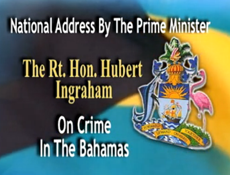
National
Address on Crime
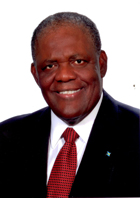
Rt. Hon. Hubert A. Ingraham Prime Minister
Commonwealth
of The Bahamas
3 October
2011
The Challenges
Confronting Us
My Fellow Bahamians:
Good
evening.
Tonight,
I speak to you on the issue of crime which is undoubtedly the most pressing
issue in our nation. Crime has become one of the greatest threats
to our way of life and to life itself.
The
security, protection and welfare of the Bahamian people are among the
most fundamental duties of my Government. These are my most urgent
responsibilities.
We
are today confronted by an intolerable level of crime, especially violent
crime, and disrespect by the criminal class for life and for the Giver
of Life.
We
are confronted by criminals -- a criminal class of older seasoned offenders
as well as a crop of bloody-minded juvenile offenders and thugs who
seem to believe that they can evade the rule of law with little or no
regard for life and other people’s property.
For
some, life is cheap; our common welfare is of no value.
I
share your anguish and anger whether you or a family member or neighbour
has been a victim of crime.
This
vicious assault of crime affects us all. It destroys lives and
damages livelihoods.
Most
particularly it threatens the future of our youth, the majority of whom
daily choose to live good lives, study ardently, participate in health
and life-affirming activities in sport, in the arts and through volunteerism.
We owe it to that majority of our youth and to all our God-fearing citizens
to reassert all that is good and decent in our heritage and to unite
to stop those who seek to disregard and destroy that goodly heritage.
Our great ally in combating criminality is the rule of law. In a matter of days my Government will introduce legislation in Parliament to further aid in the shared battle we are waging against criminality. During the debate on these laws, I will, along with my colleagues, share with you in detail the measures we are pursuing to strengthen our laws and our resolve. The arsenal and tools we must use in this shared and common fight against crimes and criminality must also include faith- and community-based responses. Government and other institutions are no substitute for personal responsibility and family life.
More broadly and urgently, our cause
must be for a future that is more peaceful and nonviolent.
We
did not arrive at this grave state of affairs overnight. Still,
our dual challenge is to respond to the immediate effects of crime as
well as the longer term causes and solutions to violence and anti-social
behaviour.
How We Got
Here
and What Your Government is Doing
My Fellow Bahamians:
To
combat crime and its various causes requires us to understand how we
got here, and that we all have a role to play in confronting this complex
and vexing national challenge.
Today’s
culture of crime and criminality has deep roots and multiple causes,
all of which must be addressed by each one of us.
In far-reaching and destructive ways, those roots and causes sank deep into our culture feeding off and growing from the rampant drug trafficking and gangsterism which ran wild in the 70s and 80s. Among the casualties of that period were some of our sons and daughters who became addicted to the ill-gotten gains of that trade. Tragically, others became addicted to drugs like crack cocaine which ravaged their minds and their bodies as well as their dreams and potential. Rampant materialism laid waste to long-held values and positive social mores. Family life suffered as too many parents and even grandparents traded traditional values for materialism, such as new satellite dishes, fancy cars, expensive jewellery and trips abroad.
Today,
in addition to a more entrenched culture of criminal violence, there
is also a gun culture. Supporting that culture is ready access
to all manner of illegal weapons smuggled into The Bahamas. We
will address this issue.
We are increasing the number and frequency of random searches of general imports by Customs with a view to discovering illegal weapons which are sometimes concealed in general imports of household appliances and dry goods, vehicles and or components and parts.
It
will also require improving the tracking of weapons entering the country
legitimately on visiting pleasure craft so as to ensure that each and
every firearm departs The Bahamas on the vessel on which it arrived.
My Fellow Bahamians:
It
is our firm conviction that removal of the unlicensed firearms from
our society will substantially reduce the level of crime and pain in
our society. Toward this end the Police Force is strengthening and expanding
the reach and intensity of action by its special task forces dealing
with firearms and drug houses.
At
the same time amendments to the Firearms Act and to the Dangerous Drugs
Act together with new legislation for the control and regulation of
Pawnbrokers and Second-hand dealers will add new teeth to police initiatives
to identify and shut down drug houses and to closely regulate pawnbrokers
and second-hand dealers (e.g. cash for gold and scrap-metal operators)
so as to stop the sale of stolen property.
I
advise that we are expanding by two the number of magistrate courts
dealing exclusively with drug and gun crimes. This will bring
to four the number of courts dedicated to hearing matters of individuals
charged with drug and gun crimes.
I
announce this evening that for a period of 30 days following the introduction
of the amendments to the Firearms Act on Wednesday 5 October 2011 all
citizens and other persons are requested to turn in to the Police any
and all unlicensed firearms in their possession.
After
the 4th November anyone convicted of unlawful possession
of a firearm or ammunition will, upon conviction, be imprisoned for
a minimum of four years. I highlight the fact that the power of
magistrates to impose sentences is being increased from five to seven
years and that conviction on drug and gun related offences may attract
the maximum sentence of seven years.
I
also advise that the penalty for the possession and sales of drugs discovered
within one mile of a school will be six years.
Fellow Bahamians:
The
supply and use of illegal drugs have exacted a terrible toll on our
communities. Drug traffickers, foreign and Bahamians, years ago
determined that the supply of their illicit goods to Bahamian facilitators
would win them both business partners and faithful customers.
The demand for drugs has grown exponentially in The Bahamas over the
past three decades. And, while well-intentioned, our anti-abuse
and demand reduction drug initiatives have not been as continuous or
sustained as they might have been.
A
creeping culture of lawlessness has led to a tolerance of petty crimes,
small-theft and the defrauding of Government and others which sometimes
opens the doorway to tolerance of even more serious crime.
Adding fuel to the fire is the length of time it takes to bring some offenders to trial and or the relative ease with which bail is available to hardened criminals and known repeat offenders who have contributed significantly to the present wave of crime. Fellow Bahamians: In the fight against crime my Government has taken immediate action and continues to pursue medium- and longer-term measures to bolster our anti-crime campaign. We have:
The
police are particularly pleased with plans to expand CCTV coverage because
of the threefold benefits of the presence of the cameras in high crime
areas, i.e. crime prevention, crime detection and evidence production.
It is important to recognize that CCTV footage is admissible evidence
in court.
With
a view to strengthening the Police Force’s anti-crime fighting arsenal
even further, we have reviewed measures effectively used in other jurisdictions
to strengthen policing. We are poised to introduce a number of those
measures determined to be most appropriate to our needs.
In
this vein, in February of this year we paid for two highly-equipped
mobile command centres for the Police Force. Made to order, the
first of the mobile police units is ready for delivery. The second one
will follow. Training in the use of this strategic asset commenced
today.
These
specialty mobile police stations are an essential addition to our crime
fighting arsenal. Basic features of the units include video recording
capabilities, flat screen monitors for viewing; specialized recording
equipment, and high-tech police lighting/siren/public address system.
These units can be dispatched to any location in New Providence to serve as a mobile police station in support of anti-crime measures including during special operations. They will be used in high crime areas in support of community policing and during situations requiring high-visibility police presence.
They
will provide easy access to the police for residents and crime witnesses
to give statements or other information at the scene of an incident.
The
specialized lighting and built in generator allow the mobile police
station to run for long periods of time on-scene.
We
propose, over the coming months to institute especially targeted training
programmes to enhance the investigatory skills of the Police Force.
While such training is ongoing and typically takes place overseas, what
is now proposed is to mount the courses locally with the assistance
of specialist consultants.
Fellow Bahamians:
We
know that the grant of bail to fewer repeat offenders will help to reduce
the number of murders, armed robberies, rapes, house-breaking and stealing,
and the rate of crime.
Indeed,
many witnesses to crime are afraid to come forward for fear that their
identity will become known to the accused. The intimidation of
witnesses is negatively impacting some prosecutions. So as to
address this problem legislation will be put in place to authorise the
non-disclosure of a witness’s identity in specific circumstances and
under certain strict conditions.
I note that Parliament is unable to prevent the Supreme Court from granting bail. Parliament may do so in respect of Magistrates Courts, and Parliament will be moved to do so. Parliament can and Parliament will be moved in the coming days to require, by statute, that a Judge, prior to the grant of bail to a defendant in murder, armed robbery, and rape cases, be satisfied that the accused:
Where
a Judge is so satisfied and grants bail, the reasons for doing so must
be put in writing. And, the Attorney General may appeal such a
decision, and if he does so, the accused is not to be released on bail
until the appeal is heard and determined by the Court of Appeal.
Fellow Bahamians:
The
last time the death penalty was carried out in The Bahamas was in January
2000, some 11 years ago. Up to that time, the Privy Council said
we were constitutionally and legally permitted to execute convicted
murderers.
Some
six years later, in 2006, the Privy Council said it was not constitutional
to have a mandatory single penalty of execution for murder. As
a result, we have been unable to administer that punishment since our
return to office in 2007.
On
my watch as head of Government five individuals were executed.
In
response to the ruling of our highest court, amendments will be made
to our law. The amendment will retain the death penalty as a punishment
and will add an alternative penalty of life imprisonment. Where
life imprisonment is imposed as an alternative to a death penalty
the sentence will be for the remainder of a convicted individual’s
natural life.
For
persons convicted of murder who are not sentenced to death, the alternative
penalty of life imprisonment will be imposed where the victim is a witness
or a party in an action (civil or criminal), where a member of a jury
or past jury in a criminal case is murdered, where the offence is in
relation to the murder of more than one person, or where the convict
had been previously convicted of murder and when the murder was committed
on the direction of another. The sentence of death would also
apply where the victims is a member of the Police Force, Defence Force,
Customs, Immigration and the Prison Services, members of the Judiciary,
or where the murder occurred in the commission of a robbery, rape, kidnapping
or an act of terrorism.
In other murder cases where a death sentence is not applicable, the
penalty will be a term of imprisonment of between 30 and 60 years.
I note that such sentences are not applicable to convicts who are 18
years or younger at the time of their conviction.
My Fellow Bahamians: As you may be aware the Government has for some time been engaged in the process of improving the facilities of the Supreme Court and the Magistrates Court.
It
is expected that by the 1st January, 2012 we will have at least five
courts instead of four courts in which criminal trial will be conducted
on a daily basis in New Providence. This is in addition to a court in
Grand Bahama in which criminal trials are conducted year round.
I have been advised by the Chairman of the Judicial and Legal Services Commission that the services of an experienced judge has been secured to serve as a new and additional Justice of the Supreme Court beginning on 1st January, 2012. The Supreme Court, in addition to dealing with outstanding matters, has assigned a court to deal with current matters to ensure that these matters do not become outstanding matters. With the new Supreme Court in New Providence, it is hoped that at least two courts will be assigned to deal with current matters. The Magistrates Court complex on Nassau Street is nearing completion. This complex will permit all Magistrates Courts to be located in one complex with their own holding cells for prisoners. We expect that this will eliminate many of the delays in starting and completing trials previously experienced when the courts were located in a number of locations and prisoners had to be transported from the Central Police Station to the courts at different locations. A new Magistrates court for Remand Hearings is now ready. Amendments will be offered to provide for hearings relating to persons held on remand to be conducted electronically via live video feeds. This will obviate the need for large numbers of persons held on remand to be transported to appear before a magistrate downtown or on Nassau Street. Social Intervention
Fellow Bahamians:
There is no denying the role played by young males in the crime scourge of our nation. These males are predominantly from the urban areas of the country, most particularly Nassau and to a lesser degree, Freeport. We cannot bury our heads in the sand about this reality. To address this reality, the Government will make $1 million available immediately to initiate programmes within urban areas of Nassau and Freeport. These programmes will be developed and executed in conjunction with social partners such as the church, civic groups and sporting groups. The funds for these new initiatives are in addition to the resources that are already budgeted for various urban renewal and youth development programmes in Nassau and Freeport.
The
Ministry of Labour and Social Development will spearhead this effort
together with the Ministry of Youth Sports and Culture. We expect
these programmes to be up and running by as early as December of this
year.
A Call to National Volunteerism Fellow Bahamians: I must speak clearly on this. With its best efforts, the Government alone will not be able to fully address this scourge of crime. We need as many of you who care about our nation to enlist in this fight. I am therefore calling you to a new era of national volunteerism. We will launch on November 1, 2011, a National Volunteers Register. This register will enable you to sign up to be available to volunteer your time for mentoring our young men and women; assisting in community centres with afterschool programmes; outreaches to urban neighbourhoods to encourage parental and child involvement in school activities; to work with existing youth organizations in their programmes; and a host of social activities that can positively impact upon our society. You will be able to register online or at various designated government offices. Our aim is to enlist hundreds if not thousands of volunteers. This effort will also be spearheaded by the Ministry of Youth, Sport and Culture together with the Ministry of Labour and Social Development. Fellow Bahamians:
One
of the social dimensions to fighting crime is social intervention which
can play an essential role in deterring crime, stopping first offenders
from re-offending and rehabilitating some criminals.
Accordingly, my Government will continue to work with and strengthen partnerships with civil society generally. We will collaborate with churches, civic groups and the business community to fund and manage targeted social intervention programmes to confront anti-social and criminal behaviour among various groups. In our shared fight against crime, there is an urgent need for more community service and mentoring and greater corporate citizenship and philanthropic efforts inclusive of helping to fund and sustain various youth and young adult programmes as well as crime prevention and offender rehabilitation programmes. The four principal areas we are targeting are:
Towards
this end, the Minister of Education has been charged with implementing
a new and more comprehensive community service-learning programme for
all Government schools. This is with a view to helping more young people
develop a sense of belonging in our community and deeper sense of responsibility
for its well-being while better respecting themselves and others.
The
Ministers of Education, Labour and Social Development and Youth, Sports
and Culture will collaborate on the development of a programme like
the highly successful Outward Bound Programme which may help steer at-risk
youth and first-offenders away from a life of crime.
Simultaneously,
these Ministries and Departments will collaborate toward improving the
programmes available for youths at the Simpson Penn and Willamae Pratt
facilities with a view to improving the results being achieved in preparing
these young people for reintegration into the community with skills
to pursue productive lives.
Conclusion:
Building a More Peaceful Culture & Restoring Community
My Fellow Bahamians:
I
have addressed you on numerous occasions. Yet, tonight is one
of the more distressing national addresses I have had the solemn duty
of giving.
It
is distressing not mostly because of the murder count and high incidence
of violent crime as painful as are these numbers. It is what those
numbers represent that is heart-breaking. For all of our good
fortune as a country, we have in significant ways lost a sense of ourselves
and of what is essential. One writer reminds us that “what is
essential is invisible to the eye.”
While
the bonds and threads of community may be invisible to the eye, their
absence or presence is plain for all to see. We know that peace
is not merely the absence of violence. Instead, we know that it is a
sign of community and mutual respect.
So,
we long for something more than the outer trappings of material success.
We long for something more, like community and fellowship. We
long for something more, like peace and well-being.
Remember
when the old people used to tell us that all you have is your good name
and your reputation and that you don’t leave this Earth with any of
your worldly goods.
Our most precious possessions are invisible to the eye like a good conscience
or the service we give with no expectation of recognition or reward.
This
crisis of culture and community manifested in an unprecedented level
of criminality requires us to deal with essentials invisible to the
eye like values, attitudes, social trust and mutual respect.
We
will get the crime numbers down. But most crimes are symptoms,
not root causes.
Even
as we relentlessly combat the criminals, provide law enforcement and
the judiciary with the tools and resources they require and modernize
our laws, there is something else as urgent, as essential -it is urgent
and essential that we renew, restore and replenish our sense of community
choosing a culture of life over a culture given over to deadly violence.
From
where shall we draw inspiration? Where do I find hope?
We
find inspiration and hope in the young man who turned from the business
of crime to running a small landscaping business. Early one morning
his mother heard tapping on the window. She thought it was her
son’s former criminal associates, only to find out that they were
his work crew headed out on a contract from the Ministry for the Environment
to help beautify New Providence.
We
draw inspiration from the work of groups like the Peace and Justice
Institute of the Bahamas Conference of the Methodist Church, which along
with other denominations are organizing faith-based alternative sentencing
programmes for juvenile offenders.
We
find hope in the many service clubs, civic groups and thousands of public
and private school students who render community service to their fellow-citizens
including some of the least-fortunate among us.
And
we draw courage and determination from that anthem of hope and inspiration,
“Get Involved” by the late Tyrone Fitzgerald, “Dr. Off”.
Fellow Bahamians:
Poverty
is not an excuse for crime. I too grew up poor.
A two-parent family is our ideal. I am the child of a single parent and I was raised by my Grandmother. Many children from two-parent families get caught up in crime while many children from single-parent households are good citizens and fine young people. In the end, it is the quality of parenting, not the quantity that is essential.
I
grew up in what was then a remote part of Abaco called Cooper’s Town.
I came up at a time when there were few opportunities for a poor boy
like me born to a single parent. The first time I met my father
was when I was 11years old.
Even
though I didn’t possess material wealth, I had wealth more everlasting:
Mama, who instilled in me a sense of my own worth as belonging to her
and as a child of God.
She
schooled me in the knowledge that the land of my birth, The Bahamas
we all love, is a land of opportunity for anyone willing to work hard.
As
a boy, never in my wildest dreams could I ever imagine becoming an attorney,
Member of Parliament or minister of government let alone prime minister.
But having been given this great privilege I have dedicated my public
life to providing every Bahamian boy and girl with opportunities I never
had.
This
is why I have never stopped working to make sure that every Bahamian
child on every island in every settlement in The Bahamas has decent
schools and access to higher education. This is why my Government
ensures that everyone meeting a certain criteria and academic standards
can attend the College of The Bahamas at public expense. And that
is why since coming to office in 2007 we increased scholarship funding
from $400.000 to $7.75 million. And this does not include bonded
scholarships, the All Bahamas Merit Scholarship or Bahamas Commonwealth
Scholarships.
I
say to you, young Bahamians: While your country may give you a hand-up,
you are not entitled to hand-outs.
So,
even while we have much to improve as a country including the quality
of our public education system, young Bahamians, men and women, you
have more opportunities than any generation in Bahamian history.
And
so we must not throw up our hands or find easy excuses; instead let
us unite to help to restore law and order and civility and community
by getting involved. In the words of Dr. Off, we can get involved.
Indeed for the sake of our children and ourselves, we must get involved
in:
Making sure our children finish their homework; Mentoring and tutoring students who need a caring adult; Assisting the police in identifying criminals; Community service programmes for at-risk and other youth;
Crime
and neighbourhood watch programmes.
Unless
more of us get involved, none of us are truly safe. In the end,
community engagement and service will be more effective in combating
crime than iron bars and gated communities.
Our
task is not only to stop criminals from breaking into our homes and
businesses. As urgently we must stop them from wanting to
do so in the first place.
And, we will do both.
My
Fellow Bahamians:
I
close tonight by invoking the guidance and protection of Almighty God
on our country. We are a blessed people, a people of hope and
resilience, faith and fortitude.
In the spirit of Psalm 121, just as another people did at another time
of lamentation we pray:
“I
will lift up mine eyes unto the hills, from whence cometh my help.
My help cometh from the Lord, which made heaven and earth.”
With
God’s guidance, unity of purpose and unyielding resolve we will ensure
greater law and order, we will ensure greater peace in our Bahamaland.
I
thank you for listening. Good Night.
Related News Story: Bahamas PM vows to root out criminals
|