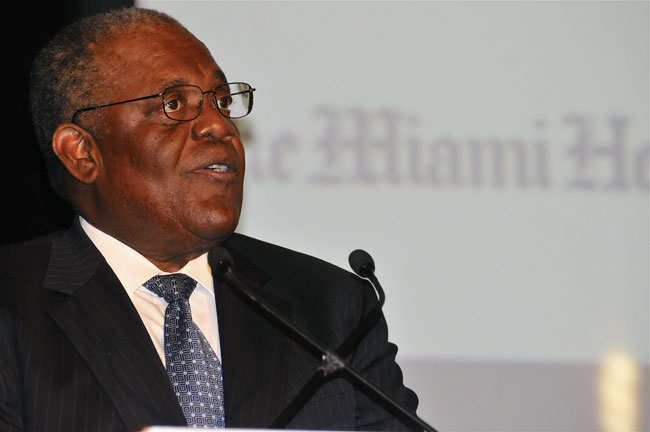
Prime Minister the Rt. Hon. Hubert Ingraham addresses the 2009 annual Americas Conference held at the Biltmore Hotel, Coral Gables, Florida on Tuesday, September 29, 2009. (BIS Photo)
|
Florida, USA -
The following are remarks delivered September 29th at the 2009 Annual Americas Conference by Prime Minister the Rt. Hon. Hubert Ingraham.
Remarks
Rt. Hon.
Hubert A. Ingraham
Prime Minister
Commonwealth
of The Bahamas
Americas
Conference, Miami, Florida
Tuesday,
29 September, 2009
Ladies and Gentlemen:
I am very happy
to be in Miami to address this distinguished gathering. I thank
the World Bank, the State of Florida, Florida International University
and the Miami Herald, for continuing to bring focus to Latin America
and the Caribbean, particularly so during the current global economic
crisis.
In The Bahamas
we often say, only half in jest, that Miami is the capital of the Caribbean.
Certainly, for my country Miami is the gateway not only to and from
much of our region, but also to the world.
South Florida
is the primary departure point for visitors to The Bahamas whether by
sea or by air; it is home to many of our second-home owners and significant
investors in our local economy; and, it is our major shopping centre
– at both the retail and wholesale level.
Every year
Bahamian visitors, shoppers and consumers spend more that $1 Billion
in the Florida economy.
It is therefore
most appropriate for all of us to ponder what life and living standards
would be like for us after the global economic and financial tsunami-like
crisis we all face ends.
Authorities
all around the globe have taken massive actions to deal with the financial
crisis. Never before has a crisis had such a widespread global
impact as the one we are now witnessing. It dramatically demonstrates
the pervasive influence of the US economy in the global economy.
For almost two years now we have endured a housing crisis, a fuel price
crisis, a food price crisis and a financial crisis. The results
have been job losses, high levels of unemployment, and greatly reduced
levels of foreign direct and domestic investment and reduced incomes.
In The Bahamas
our prospects for the future, before the crisis, had been promising.
Now we have substantially reduced levels of investments, weakened tourism
arrivals and expenditures and declining government revenue. At
the same time demands for social services spending increased sharply,
the national debt increased as a percentage of gross domestic product
and credit markets became more difficult to access or afford.
The catastrophic
failure of Lehman Brothers not only precipitated the worst aspects of
the global financial crisis but also directly impacted a number of high-end
resort developments already underway in The Bahamas, not only in New
Providence but also in a number of our Family Islands, and slowed the
progress of other resorts and residential projects in advanced planning
stages.
The number
of stalled investment projects cost jobs to be lost in the important
construction sector, and stymied job creation opportunities directly
and indirectly in the tourism sector. Power houses in our hotel
sector like Atlantis and Baha Mar were forced to postpone plans for
further expansion and redevelopment.
New regulations
of financial institutions receiving Tarp funding from the US Government
reduced their ability to conduct off-site conventions and sponsor benefit
travel for employees. This brought about a reduction for us of
benefits under the Convention Tax Benefit included in the Tax Information
Exchange Agreement concluded with the US Government.
Our new circumstances
have increased the weight of the burden created by the continuing need
to fund initiatives to combat not only undocumented migration from Haiti,
which has increased in response to the further deteriorated economic
conditions in that country, but also to confront the traffic in illicit
drugs and arms through our country.
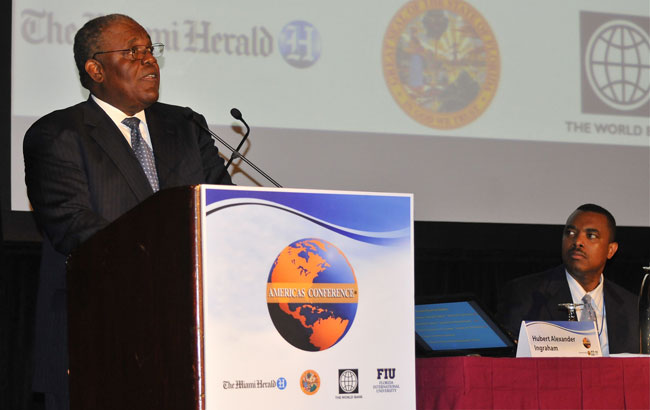
Prime Minister the Rt. Hon. Hubert Ingraham addresses the 2009 annual Americas Conference held at the Biltmore Hotel, Coral Gables, Florida on Tuesday, September 29, 2009. (BIS Photo)
|
These are the
realities with which many developing countries are confronted.
Our prospects for the future will depend greatly on whether we make
the appropriate governmental response now.
The Bahamas’
GDP of roughly $7.5 billion is sustained by international services,
mainly tourism and the foreign direct investment that supports it, and
by financial services.
With a very
small and extremely open economy, The Bahamas comprises an archipelago
of some 700 islands and more than 2,000 cays scattered over 100,000
square miles of the Atlantic Ocean, running south just 80 miles from
the coast of Florida. Its population of 350,000 enjoys the third
highest per capita income of any independent country in the Western
Hemisphere, just after the United States and Canada.
In the absence
of an income or sales tax, government revenue relies heavily on import
tariffs and real estate taxes. Like the economy, government revenue
is also extremely vulnerable to external shocks. The revenue base
is quite narrow and amounts to less than 20 percent of GDP.
Because of
the enormous economic openness and the commitment to a fixed parity
with the United States dollar for some 37 years, the maintenance of
fiscal sustainability has historically been the centrepiece of our macroeconomic
policy. This has enabled us to maintain a level of government
debt to GDP of between 30 to 35 per cent prior to the crisis.
In the decade
leading up to the crisis, the overall fiscal deficit averaged about
two per cent and the primary balance approached zero. This economic
stability has been important in attracting the level of foreign direct
investment that drove the tourism expansion in the last decade.
Following the
terrorist attack of September 11th 2001, the economy went
into rapid decline, but by 2003 foreign direct investment had risen
to over 10 per cent of GDP and in the six years to 2008 had averaged
more than 13 percent of GDP per annum.
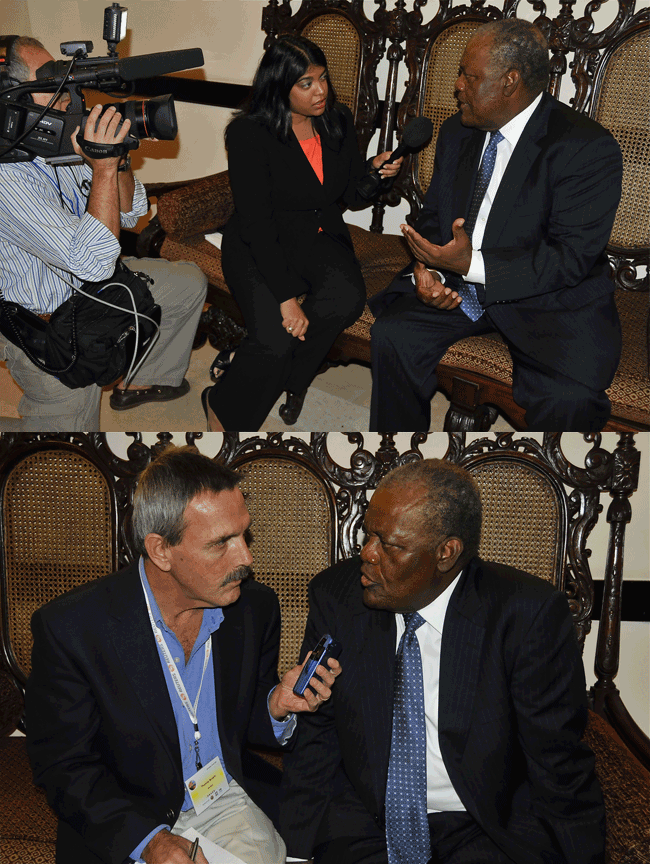
SLIDE SHOW: Prime Minister the Rt. Hon. Hubert Ingraham talks to Miami Herald Business and Reuters news agency on Tax Information Exchange Agreements and the Bahamian economy at the 2009 annual Americas Conference held at the Biltmore Hotel, Coral Gables, Florida on Tuesday, September 29, 2009. (BIS Photo)
|
(Read the Miami Herald report HERE and another related article HERE)
However, economic
growth, which is driven primarily by foreign direct investment, was
slow to respond to the resurgence in FDI following the collapse in 2001
and the economy remained flat for the next three years. Unemployment
which was at 6.9 per cent in 2001 rose rapidly to 10.8 per cent in 2003
and remained above 10 per cent until 2006 when it fell to 7.6 per cent.
Economic growth
returned in 2005 and averaged five per cent per annum until 2007 when
it again experienced a slow-down. In 2008 economic growth went
into negative territory and there it remains. Unemployment is
again on the rise and is now estimated at over 14 per cent.
As we are often
reminded in The Bahamas, tourism matters. It is the engine of
our economy. The full impact of the global crisis hit the Bahamas in
September, 2008, with a drop in tourism receipts, a fall in FDI and
a deceleration in private sector credit.
Through to
July this year, tourism is showing an overall visitor increase of 4.2
per cent, but the important stop-over segment is off from the previous
year by 13.7 per cent. This significant drop in air arrivals accounts
for a considerable reduction in tourism receipts across the breadth
of the economy. This tourism weakness is reflected across all
the Bahamian tourism destinations.
In the face
of growing unemployment, decelerating private sector credit and falling
foreign direct investment, policymakers in an extremely open small economy
have relatively little room for manoeuvre.
Fortunately
for us, the fiscal discipline that we earlier established as our principal
macroeconomic strategy afforded some small headroom and we availed ourselves
of it.
We eased the
economic hardship on the most vulnerable in our country while maintaining
the public sector’s level of employment and other recurrent spending.
And we did this without adding to the tax burden of the private sector
which was itself a victim of the economic weakness.
In the circumstances,
the level of government borrowing will necessarily rise substantially.
It is envisaged that before this crisis has ended, the level of government
debt in The Bahamas could rise well beyond 50% of GDP. And while
we will still remain well below the level in other economies in similar
circumstances we will be well beyond our own prudent threshold norm.
It must be
our committed objective to retreat with all deliberate haste from these
levels of debt when our economy returns to growth. As quickly
as possible we will move to create even more headroom to see us through
the next inevitable down-turn on the assumption that no miracle economic
model will emerge to relegate economic cycles to the dust bin of history.
And so, as
the world looks beyond the greatest economic crisis since the Second
World War, Small Island Developing States are painfully mindful of the
extent of their dependency and the paucity of options available to them
in confronting a serious economic crisis.
The speed with
which the emergence of an economic crisis in one major industrial country
could become global has amazed us all, but perhaps the most unsettling
experience for mini-states was the affirmation of the limit of their
policy options to respond. In this experience is a lesson we must
take into our future economic planning as much as possible.
To date, our
strategy has been working and while the economy remains greatly strained,
it is enduring. Perhaps one of the most important lessons that
we and all developing countries can take away from this current crisis
is the importance of maintaining fiscal discipline.
Even in the
present situation, while we had to boost government spending in the
face of declining revenue, we are being careful to contain the rise
in debt to GDP ratio so as not to hinder our ability to respond quickly
to a turnaround in global economic fortunes.
As we look
forward, we must clearly take advantage of the lessons taught by the
present crisis. These lessons indicate the following:
-
We must make an
honest assessment of the risks posed to our global economic and financial
systems and avoid placing blame where it is not due;
-
We must have a better
means of assessing and responding to systemic risk in the global financial
architecture and one that demonstrates equity in calling all economies,
those of the developed and developing world, into account;
-
We must promote
greater equity in the international development process so as to make
the prospects for sustained growth of the world economy more enduring
and widespread; and
-
We must better coordinate
global resources in order to maximize use; this is especially true with
respect to those resources channelled by the multilateral lending and
aid agencies.
It has to be
accepted that the Government must be able to move quickly to effect
counter-cyclical measures and to do so it must be in a position to access
the international market. There is no other avenue on which countries
like The Bahamas can rely and that is the unmistakable lesson that must
be drawn from this global economic crisis.
This clearly
implies that such countries will pursue policies that take account of
the need to create the so-called headroom in periods of strong economic
growth. This suggests the desirability of the establishment of the equivalent
of an Emergency Fund, and I am sure other small states join me in looking
forward to such an innovation.
Thank you.