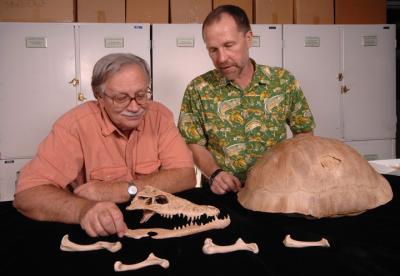
GAINESVILLE, Fla. — Richard Franz (left), a University of Florida herpetologist, and David Steadman, a UF ornithologist, view a crocodile skull and tortoise shell at the Florida Museum of Natural History on the UF campus on Nov. 27, 2007. The first entire fossilized skeletons of a tortoise and a crocodile found anywhere in the West Indies were uncovered in a kind of sinkhole called a blue hole on Great Abaco Island in the Bahamas, along with bones of a lizard, snakes, bats and 25 species of birds, as well as abundant fossils of plants, Steadman says. Radiocarbon analyses date the bones at between 1,000 and 4,200 years old, with the youngest fossil being that of a human tibia, he says.
|
Long before tourists arrived in the Bahamas, ancient visitors took up residence in this archipelago off Florida’s coast and left remains offering stark evidence that the arrival of humans can permanently change — and eliminate — life on what had been isolated islands, says a University of Florida researcher.
The unusual discovery of well-preserved fossils in a water-filled sinkhole called a blue hole revealed the bones of landlubbing crocodiles and tortoises that did not survive human encroachment, said David Steadman, a UF ornithologist and the lead author of a paper published this week by the Proceedings of the National Academy of Sciences.
“The climate and environmental conditions back then weren’t much different from those of today,” said Steadman, who works at the Florida Museum of Natural History on the UF campus. “The big difference is us. When people got to the island, there was probably nothing easier to hunt than tortoises so they cooked and ate them. And they got rid of the crocodiles because it’s tough to have kids playing at the edge of the village where there are terrestrial crocodiles running around.”
The first entire fossilized skeletons of a tortoise and a crocodile found anywhere in the West Indies were uncovered from Sawmill Sink on Great Abaco Island in the Bahamas, along with bones of a lizard, snakes, bats and 25 species of birds, as well as abundant plant fossils.
Radiocarbon analyses date the bones at between 1,000 and 4,200 years old with the youngest fossil being that of a human tibia, he said. The fossils are the best preserved of any ever found in the Bahamas because of their unusual location in the deep saltwater layer of the sinkhole that contains no oxygen, which normally would feed the bacteria and fungi that cause bones to decay, Steadman said. Expert diver Brian Kakuk and other skilled scuba divers retrieved the fossils from various places along the floor and walls of the blue hole, which contains salt water covered by a layer of freshwater.
“The fossils from Sawmill Sink open up unparalleled opportunities for doing much more sophisticated work than ever before in reconstructing the ancient plant and animal communities of the Bahamas,” Steadman said. “It helps us to understand not only how individual species evolve on islands, but how these communities changed with the arrival of people because we know that changes in the ecosystem are much more dramatic on islands than they are on continents.”
There are many blue holes on Abaco and other Bahamian islands, but this is the first to be the site of a sophisticated fossil excavation, Steadman said. Although the Bahamian government has gone to great lengths to protect its coastline, blue holes with their submerged cave passages have received little attention as a marine resource, he said.
The fossil site is especially valuable because of the presence of fossilized plants — leaves, twigs, flowers, fruits and seeds — pollen and spores, and vertebrates, giving evidence of both the island’s flora and fauna, Steadman said.
“In a typical vertebrate fossil site, you identify the species of vertebrates — reptiles, birds or mammals — and based on that identification you speculate what the habitat might have been,” he said. “For the first time here in the West Indies, we have here on Abaco plant fossils right in with the vertebrates, so we can reconstruct the habitats in a much more sophisticated way.”
For instance, because bracken ferns are one of the first plants to recolonize after a fire, the presence of their spores would indicate regular burning in prehistoric times and indicate that an area was grassland. Evidence for this also comes from the numerous fossils of burrowing owls or meadow larks, which prefer open habitats, he said.
Among the excavation’s findings are that the land-roaming Cuban crocodile lived in the Bahamas until humans arrived, Steadman said. “People tend to think of crocodiles as aquatic and certainly most of them are, but in the Bahamas where there is no fresh water, the crocodile became a terrestrial predator,” he said.
The collaborative project includes Bahamian scientists Nancy Albury, Keith Tinker and Michael Pateman, as well as paleontologist Gary Morgan of the New Mexico Museum of Natural History.
Article source