|
Last Updated: Feb 6, 2017 - 2:32:04 PM |
 Approximately
45% of all the cocaine users in the world live in the Americas, along
with approximately half the heroin users and a quarter of all marijuana
users. The consumption of cocaine paste, crack, inhalants, amphetamines
and the abuse of legal drugs has increased. Approximately
45% of all the cocaine users in the world live in the Americas, along
with approximately half the heroin users and a quarter of all marijuana
users. The consumption of cocaine paste, crack, inhalants, amphetamines
and the abuse of legal drugs has increased.
This consumption of prohibited drugs creates an illegal business
in our hemisphere that generates some 151 billion dollars in drug
retail alone.
This illegal activity has led to the rise of giant transnational
criminal networks, which have expanded their activities to include, in
addition to the production and sale of controlled substances, the
illegal trafficking and sale of arms, piracy and smuggling, human
trafficking, the control and exploitation of prostitution, theft,
illegal mining, kidnapping and extortion, and the smuggling of migrants
and organs, among other criminal activities.
In some of our countries, the activity of these criminals has
resulted in massacres, attacks carried out by assassins, torture and
deaths that have raised the death toll to hundreds of thousands of
people.
Moreover, it has led to the corruption of public and private
officials at various levels and caused damage to our economies and
institutions that, in many cases, jeopardizes our democratic governance.
Although these are realities that affect each country
differently, we are united by our concern over the problem. The
relationship between drugs and violence is one of the main causes of
fear amongst our citizens and has contributed to making security one of
the most worrying issues for the citizens of the entire hemisphere.
This situation must be faced with greater realism and
effectiveness if we want to move forward successfully. All of us who
hold public responsibilities owe it to the millions of women and men,
young and old, mothers and fathers, girls and boys who today feel
threatened to find clear answers and effective public policies to
confront this scourge.
The Heads of State and Government of the Americas, aware of
this, moved forward in Cartagena, one year ago when they gave an
explicit mandate to the Organization of American States, to “Analyze the
results of the current policy (on drugs) in the Americas and explore
new approaches to strengthen this struggle and to become more
effective.”
The Report, "The Drug Problem in the Americas," which I now have
the honor to present to the Leaders of the Hemisphere by way of his
Excellency the President of Colombia, who was the Chair of the Summit of
the Americas that commissioned it, is the result of that effort. In it,
we have thoroughly examined the available and updated information about
the size and characteristics of the consumption and the business of
illicit drugs in our hemisphere, including their effects on the security
of our citizens, on the health of our peoples, and on the quality of
our institutions and their servants. To do so we have received valuable
contributions from public servants, private specialists, academic
experts and social and political leaders from the entire hemisphere that
contributed with their opinions, their inputs in specific areas and, at
all times, with their experience and goodwill.
We have tried, in this Report, not to silence or hide anything.
To show the problem just as it is and how it manifests itself in
different ways in our various countries and sub-regions. To show the
volume of money that changes hands and who benefits from it. To show how
it erodes our social organization and how it undermines the health of
our people, the quality of our governments and even our democracy.
We called the first part of this Report the Analytical Report.
In it we offer, in first place, a definition of the problem, an
explanation of how we approached its analysis and an examination of the
reasons that led society to worry about the consumption of certain
substances and decide to put controls on them, due to the effects of
drugs on human health.
Next we follow the entire process of drugs in the region, the
part of the world in which all of its stages are present in a dominant
way: cultivation, production, distribution and the final sale of
controlled substances. In each stage we review the various forms this
activity assumes, as well as its environmental impact and the reaction
of the State, its implications and its limitations.
We also examined the consumption of the different drugs in our
countries, their effects on social exclusion and the exercise of human
rights, the possible forms of treatment and prevention practiced today
and, again, the reaction of our States.
There are two aspects connected with the process of the
production, trafficking and consumption of drugs that deserve special
attention.
The first is the so-called “drug economy.” Our Report contains
an examination of the profits generated in each stage of the process,
concluding that, while all profit in the process, the greatest profits
are produced in the final stage, the sale to consumers.
The second aspect is an examination of the various forms of
criminal violence associated with the different stages in the value
chain of the illegal drug economy, including that which takes place in
during the consumption of these substances.
On this point, we carefully considered the possible reasons why
this violence takes on greater intensity and virulence in some countries
and, in particular, why the greatest violence is not generated where
the greatest profit is generated. The most lethal criminality does not
coincide with the greatest profit-making. Probably, then, there are
other factors, such as greater or lesser institutional strength in our
countries and the greater impunity enjoyed by criminals, which promotes
the violence linked to drugs.
Finally, we analyze the legal and regulatory alternatives to
address the problem, in particular their origins and characteristics,
current trends in decriminalization, reduction of penalties and
legalization, the potential costs and benefits of these alternatives and
the review of other legal alternatives.
The Analytical Report provides, we hope a succinct summary of
the current reality of the Drug Problem. The Report on Scenarios for the
Drug Problem in the Americas 2013-2025 is an examination of the various
paths that the phenomenon could take in the coming years.
We are aware that there is not just one possible future but many
alternative or combined futures; because the complexity of the drug
problem gives rise to different visions or points of view, which are
expressed in many debates. And, on that basis, various policy options
can be adopted with very different consequences.
Starting from that premise, a group of people, specialists and
participants who have dealt with the drug problem from very different
angles, have set forth four possibilities on what the “drug problem” in
the Americas could become in the future.
None of them represents what will happen or what we want to
happen, but all of them could come to pass if certain events take place
and if some political decisions are taken. To understand these
possibilities, to analyze their causes and effects, and to draw
conclusions about them, is a task that we consider not just useful but
necessary for our individual and collective reflections on the problem.
Three of the four scenarios discussed -"Together", "Pathways"
and "Resilience" – describe alternative futures depending on the
relative weight placed on institutional strengthening, experimentation
with legal changes or the ability to react to the problem from the
community. The fourth, "Disruption," warns of what might happen if we
fail in the short term to arrive at a shared vision that allows us to
unite our efforts to address the problem, while at the same time
respecting our diversity.
From each of these scenarios a variety of collective and
multilateral opportunities and challenges emerge that should be leading
factors in the subsequent discussion. With drugs, as with any complex
social problem, there is a wide range of motivations and beliefs that
influence the social fabric. That's why we believe that the scenarios
are a good starting point for our leaders and ultimately, our people, to
arrive at collective and sustainable policies in the midst of
diversity.
President Santos:
As I have said, by mandating us to prepare this report, the
Heads of State of our hemisphere gave us a great responsibility. At the
same time, they prescribed very precise limits for our response to it.
That is why we lay out facts that will assist in decision-making, but do
not propose solutions. That it is up to our leaders, who will have a
firm basis for their deliberations in future debates.
However, we have allowed ourselves to draw some general conclusions, found at the end of the Analytical Report:
First, although the drug problem in the Americas is expressed in
a single process, it allows for different treatments in each of its
phases and in the countries in which they take place.
The health problems associated with substance abuse are
certainly present in all our countries, as there is evidence of drug use
in all of them. However, although the increase in consumption in South
America is alarming, the use of drugs is still greater in the countries
in the north of North America, which, together with Europe, continues to
be the main destination for drug trafficking from our hemisphere.
By contrast, the impact on the economy, social relations,
security and democratic governance is greater in the countries where
cultivation, production and transit take place, located in South
America, Central America, Mexico and the Caribbean.
Second, while some countries have greater resources and stronger
institutions to better address damages related to the illicit market
and illegal drug use, others suffer a clear institutional weakness that
leads to a practical inability to address the problem.
The links between drugs and violence in our countries are
complex, with greater impact on those countries in which the State is
not able to deliver effective responses.
Those countries in which criminal activity reaches more intense
levels of violence and cruelty are also the countries where the
geographical reach of institutions tends to be limited, which suffer
from a lack of coordination and institutional articulation, limited
financial and human resources, and a lack of information needed to guide
the definition and implementation of security policies.
Moreover, there exists, a situation of widespread impunity,
which explains the existence of an equally widespread culture of lack of
respect for the State. In the context of this lack of respect for the
State, a vicious circle is created in which the community decides not to
use the institutions (crimes are not reported, disputes are resolved
privately, people take justice into their own hands) because the police
do not chase offenders, courts do not deliver justice, and prisons do
not rehabilitate and often serve as a haven for criminals who continue
to operate as such from behind bars.
We recognize that there are probably other conditions that help
explain the rule of crime and violence in some of our countries. That
our individual histories as nations, our cultures and idiosyncrasies and
especially the situations of poverty and social inequality that
characterize some countries, are also present, in a decisive way, in
explaining this phenomenon. However, it seems equally undeniable that at
the core of any solution there will always be a need for formal
institutions that effectively ensure public security and truly ensure
the welfare and prosperity of all.
Third, drug consumption requires a public health approach in all
of our countries, with more resources and more programs in order to
succeed.
National, international and hemispheric policies on drugs have
gradually adopted the view of dependence as a chronic, relapsing
disease, which requires a health-oriented approach that integrates a
wide range of policies. These include promoting healthy lifestyles,
protecting users with measures to limit the availability of psychoactive
substances, prevention, treatment, rehabilitation and social
reintegration.
Drug treatment should be present at all levels of general and
specialized care in the health system, with special emphasis on early
detection and timely intervention at the primary care level. In our
report we show that there is a significant gap between the vision of
public health and care services for problems of psychoactive substance
consumption in many of our countries.
Fourth, addressing the drug problem requires a multi-pronged
approach, with great flexibility, with an understanding of different
realities and, above all, the belief that, to be successful, we must
maintain unity in diversity.
Greater flexibility could certainly lead to acceptance of the
possibility of changes in national legislation or to promoting changes
in international law. From there, if one accepts the fundamental notion
that drug use is not a criminal act, then users should not be subject to
punishment, but to care and rehabilitation.
Also, it is important to recognize that there is an ongoing
debate about the legalization or de-penalization of marijuana with
initiatives underway in some of our countries, as well as a disposition
to deal with the issue that does not exist with respect to other drugs,
such as heroin, cocaine and amphetamines, where the proposals for
legalization or de-penalization are largely rejected.
Naturally none of these changes should put in doubt the advances
made thus far in terms of collective action on drugs in our hemisphere,
but rather should build, on this basis, more realistic policies, which
consider the needs of the individual, and also the needs of the whole.
In that balance between the individual and the collective,
between national sovereignty and multilateral action, we have based our
coexistence and all the associative structures that we have created in
the course of our histories as nations that are independent but united
and supportive in the international arena.
President Santos, officials, distinguished guests.
With this, the OAS General Secretariat has responded to the
explicit mandate that the Sixth Summit of the Americas conferred upon
us.
By delivering this Report today, through you, we are encouraged
by the sincere aspiration, which I now have the privilege of presenting
to the entire hemisphere, that it is not a conclusion but only the
beginning of a long awaited discussion.
Thank you.
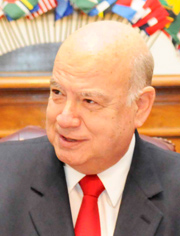
The
following documents are available from the Report on the Drug Problem
in the Americas, which was presented today by the Secretary General of
the OAS, José Miguel Insulza:
Introduction and Analytical Report
Scenarios Report
Highlights

© Copyright 2013 by thebahamasweekly.com
Top of Page
|