|

|
|
|
Last Updated: Feb 6, 2017 - 2:32:04 PM |
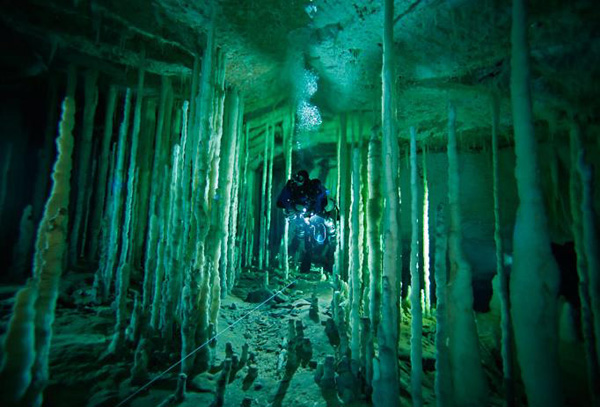
National Geographic photo by Wes C. Skiles
|
(National Geographic)
The blue holes of the Bahamas yield a
scientific trove that may even shed light on life beyond Earth. If
only they
weren’t so dangerous to explore.
We sink into Stargate, sweeping the void with our dive lights. Fifty
feet from the surface looms a pale haze, less smoky than fibrous, like a
silvery net of faint, swirling cobwebs hovering motionless in the
darkness. It's a layer of hydrogen sulfide, a toxic gas created by
bacterial colonies and decaying organic matter. Divers entering the gas
may experience itching skin, tingling, or dizziness; some smell rotten
eggs as it penetrates their skin and metabolizes through their lungs.
The gas density in Stargate is relatively low, but I'm struck by a wave
of nausea as we descend. I glance at my guide, Brian Kakuk—one of the
world's foremost cave divers. He appears unfazed. My head begins to
throb; clearly, I'm unusually sensitive to the toxin. In the epic poem
Beowulf,
"dim serpent shapes" in the depths guard the lake of Grendel and his
mother, shielding their lair. The otherworldly mist in Stargate appears
to serve a similar role—a poisonous curtain that protects the deeper
reaches of the cave.
Offshore flooded caves, so-called ocean blue holes, are extensions of
the sea, subject to the same heavy tides and host to many of the same
species found in the surrounding waters. Inland blue holes, however, are
unlike any other environment on Earth, thanks largely to their geology
and water chemistry. In these flooded caves, such as Stargate on Andros
Island, the reduced tidal flow results in a sharp stratification of
water chemistry. A thin lens of fresh water—supplied by rainfall—lies
atop a denser layer of salt water. The freshwater lens acts as a lid,
isolating the salt water from atmospheric oxygen and inhibiting bacteria
from causing organic matter to decay. Bacteria in the zone just below
the fresh water survive by exploiting sulfate (one of the salts in the
water), generating hydrogen sulfide as a by-product. Known on land as
swamp or sewer gas, hydrogen sulfide in higher doses can cause delirium
and death.
Read MORE
Photo Gallery

© Copyright 2010 by thebahamasweekly.com
Top of Page
|
|
|
|